
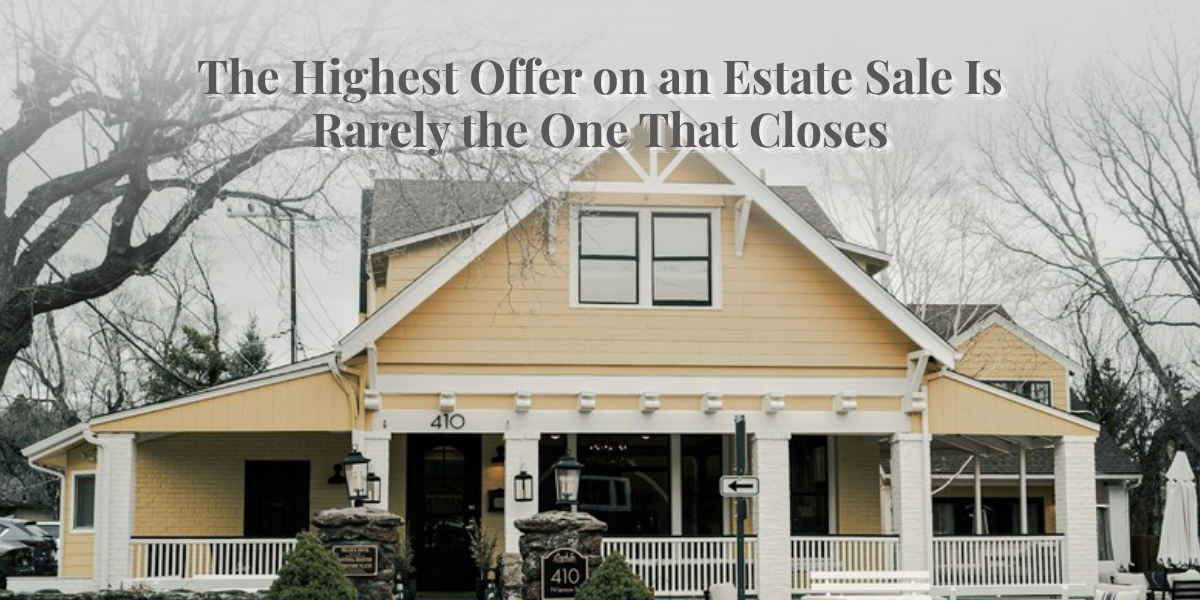
Here’s a pattern I’ve watched repeat across 24 years of trust property sales in San Mateo County: the estate accepts the biggest number on the table, everyone exhales — and sixty days later the house is back on the market. The next best offer? Often $100,000 to $120,000 colder, because “back on market” is a scarlet letter buyers read as damage. If you’re a trustee or a wills and trusts attorney guiding one, the single most valuable thing I can tell you is this: the highest offer is a headline. The strongest offer is a close. Here’s how I vet them.
Fiduciary Duty Points to the Best Terms — Not the Biggest Number
California trustees carry a fiduciary duty to secure the best overall outcome for the trust and its beneficiaries. That is not the same as the highest price. An offer that’s $50,000 richer but collapses in escrow can cost the estate far more than the spread — carrying costs, a stigmatized re-listing, and in the worst cases, beneficiary claims against the trustee personally.
When I work with trustees in Hillsborough and Burlingame, I put it this way: your duty is to the number that actually lands in the trust account, documented well enough that no beneficiary can second-guess it. Passing on a bigger headline number is defensible — when the file shows why.
Here’s how I help: I build a written offer comparison for every trust sale I handle, so the trustee’s decision — whichever way it goes — is documented for the file.
Financing Strength Is Where Estate Sale Offers Actually Fail
Most fall-throughs I see on a trust property sale in San Mateo County trace back to financing, not price. Before the number even matters, I want to know: Is the proof of funds real and recent? Is the lender a known closer or an out-of-area unknown? Has the buyer been fully underwritten, or just pre-qualified from a web form?
A fully underwritten buyer at $2.45M is routinely a better estate outcome than a shaky $2.5M. I call every lender myself before a trustee signs anything. Five minutes on the phone has saved estates six figures.
Contingencies and Timelines Hit Estates Harder Than Regular Sellers
An occupied family home can absorb a 21-day delay. An estate usually can’t afford the same luxury — every extra week is insurance, property taxes, utilities, and sometimes a mortgage draining the trust, while beneficiaries wait and tensions rise. So I weigh each contingency as an escape hatch: How many are there? How long do they run? A clean 10-day inspection window with appraisal handled is worth real money against a 30-day everything-contingent offer.
Here’s how I help: for estate timelines, I negotiate contingency calendars up front and keep a backup offer in hand wherever possible — the cheapest insurance a trust sale can carry.
The 5-Point Vetting Order I Give Trustees
- Proof of funds and lender strength — can they actually close?
- Underwriting status — pre-qualified is a guess; underwritten is a commitment.
- Contingency count and duration — how many escape hatches, open for how long?
- Timeline fit — does their close date protect the estate’s carrying costs and distribution schedule?
- Now the price — read in context of the four points above.
Price is deliberately last. It’s the least reliable predictor of whether an estate sale closes.
Frequently Asked Questions
Q: Does a trustee have to accept the highest offer in California?
No. A trustee’s duty is to the best overall terms for the trust — price, certainty, and timeline together. Document the reasoning and the decision is defensible.
Q: What happens if a trust or probate sale falls through?
The property returns to market carrying a “back on market” flag, which buyers in San Mateo County routinely read as a defect. I’ve seen the pattern cost estates $120,000 against the original accepted price.
Q: Should an estate take a backup offer?
Almost always yes. A signed backup keeps leverage with the primary buyer and eliminates re-listing stigma if escrow fails.
Q: How is an estate sale different from a regular sale?
Carrying costs come out of the trust, beneficiaries are watching, and the trustee has personal liability exposure. Certainty of close is worth proportionally more.
Vetting Offers on a Trust Property? Let’s Talk Before You Sign
If you’re a trustee — or an attorney with a client holding Peninsula real estate — I’m happy to put a second set of eyes on the offer stack before anything is signed. It costs nothing and it’s saved estates real money. Call me at (650) 576-9565 or reach out through marktauber.com. For more on this subject on The Mark Tauber Blog, see my attorney’s guide to selling inherited trust property in San Mateo County and the keep-or-sell rental math most trustees get wrong.
Sources and further reading
- San Mateo County Assessor — local assessment records, reassessment rules and exclusion forms.
- California State Board of Equalization: Proposition 19 — how and when an inherited California property is reassessed for property tax.
About the Author:
I’m Mark Tauber, a real estate broker based in Burlingame with 24+ years of Peninsula experience and hundreds of transactions across San Mateo County — including trust and estate sales coordinated directly with wills and trusts attorneys. I rank in the top 9% of Coldwell Banker agents internationally. Reach me at marktauber.com.