

An investment property can be an important part of a long term real estate strategy, whether the goal is to generate rental income, build equity, or potentially benefit from property appreciation over time. For many people, real estate offers an opportunity to own a tangible asset while creating another potential source of income beyond a primary residence.
However, buying an investment property involves more than finding a home and putting it on the market for rent. Investors need to consider the purchase price, financing, property taxes, insurance, maintenance, vacancy, rental demand, and the condition and location of the property. A property that looks attractive at first may not produce the financial results an investor expects once all expenses are taken into account.
The San Francisco Bay Area can make these decisions even more nuanced. Property values, rental markets, neighborhoods, and investment opportunities can vary significantly from one community to another. Understanding local market conditions and evaluating each property carefully can help buyers make more informed decisions.
Mark Tauber Real Estate is a residential real estate team that helps people buy and sell real estate throughout the San Francisco Bay Area. With local market knowledge and experience in residential real estate, the team helps clients navigate important decisions related to Buying A Home, Selling Your Home, and exploring opportunities that may involve an investment property.
In this guide, we will explore what an investment property is, the different types of properties investors can consider, and whether purchasing one can be a smart financial decision. We will also explain the 2% rule, explore whether $5,000 is enough to invest in real estate, and look at how investing $1,000 each month for 30 years could grow through the power of compounding.
Whether you are considering your first rental property, thinking about turning a future home into an investment, or simply learning more about real estate investing, understanding the fundamentals can help you approach your next decision with greater confidence.
What Is the Definition of an Investment Property?
An investment property is real estate that is purchased or acquired primarily to generate income, earn a return, or benefit from long term appreciation rather than being used solely as the owner’s primary residence. The income may come from renting the property to tenants, while the potential return may also come from an increase in the property’s value over time.
Investment properties can take many forms, from a single family home that is rented to a tenant to a larger multifamily property with several rental units. The right type of property depends on the investor’s financial goals, available capital, preferred level of involvement, and the characteristics of the local market.
How Is an Investment Property Different From a Primary Residence?
The main difference is the intended use of the property. A primary residence is generally purchased as a place for the owner to live. An investment property is acquired primarily for financial purposes.
For example, someone may purchase a home and live in it as their primary residence. Another buyer may purchase a similar home with the intention of renting it to tenants and generating rental income. The properties may look similar, but their intended purposes are different.
Some buyers may also eventually convert a primary residence into an investment property. This can happen when an owner moves to another home but decides to retain the original property and rent it out. Before doing so, it is important to review financing terms, insurance requirements, local regulations, and the expected costs and income associated with the property.
How Can an Investment Property Generate Returns?
An investment property can potentially provide returns in several ways.
Rental income: Tenants may provide recurring rental payments that can contribute to the property’s operating costs and potentially produce positive cash flow.
Property appreciation: The market value of a property may increase over time. An investor may benefit from that appreciation when the property is eventually sold.
Equity growth: As a mortgage is paid down, the owner’s equity in the property may increase, assuming the loan balance declines and the property’s value remains stable or rises.
Potential tax benefits: Certain real estate expenses and deductions may be available to eligible property owners, depending on their circumstances and applicable tax rules. Investors should consult a qualified tax professional for advice specific to their situation.
Not every investment property will generate positive cash flow or appreciate in value. Real estate returns depend on purchase price, financing, operating expenses, rental income, market conditions, property condition, and many other factors.
Why Does Location Matter?
Location is one of the most important factors when evaluating an investment property. A property in an area with strong rental demand may have different income and appreciation potential than a similar property in a location with weaker demand.
Investors may want to consider factors such as:
• Local rental demand
• Employment opportunities
• Schools and nearby amenities
• Transportation access
• Neighborhood conditions
• Property taxes and insurance costs
• Local housing supply
• Long term development plans
This is especially important in the San Francisco Bay Area, where market conditions can vary significantly between cities, neighborhoods, and property types.
An Investment Property Is More Than a Building
It is easy to focus on the physical characteristics of a property, but successful investment analysis requires looking beyond the building itself. Investors should consider the relationship between the purchase price, expected rental income, ongoing expenses, financing, and potential future value.
A property with attractive finishes and a desirable location may still be a poor investment if the numbers do not make sense. Conversely, a property that requires improvements may offer an opportunity if the purchase price, renovation costs, rental potential, and long term outlook are favorable.
Understanding the definition of an investment property is the first step. The next step is determining whether a specific property fits the investor’s goals and financial strategy.
What Are 10 Examples of Investment Property?
Investment properties come in many forms, and not every investor has the same goals. Some buyers want a property that can generate regular rental income, while others may focus more heavily on long term appreciation. The best option depends on factors such as available capital, financing, location, property type, expected expenses, and the amount of involvement the investor wants to have.
Here are 10 common examples of investment property to consider.
1. Single Family Rental Homes
A single family home purchased specifically to rent to tenants is one of the most straightforward types of investment property. Investors may choose a home based on rental demand, neighborhood characteristics, purchase price, and potential for long term appreciation.
Single family rentals can appeal to investors who prefer owning an individual property rather than managing multiple units.
2. Multifamily Properties
Multifamily properties contain multiple residential units within the same property. Duplexes, triplexes, and larger apartment properties can fall into this category.
One potential advantage is that multiple rental units can provide several sources of rental income. However, these properties can also involve greater management responsibilities, maintenance requirements, and operating expenses.
3. Condominiums
A condominium can be purchased as an investment property and rented to tenants, subject to applicable building and association rules.
Condos may appeal to investors who want residential rental property with less exterior maintenance responsibility than some single family homes. However, buyers should carefully review homeowners association fees, restrictions, reserves, and rental policies before purchasing.
4. Townhouses
Townhouses can also serve as rental properties. They may offer a middle ground between single family homes and condominiums, depending on the property and ownership structure.
Investors should consider the property’s location, rental demand, association requirements, maintenance responsibilities, and overall operating costs.
5. Duplexes
A duplex contains two residential units. An investor may rent both units or, depending on the circumstances and applicable financing and occupancy rules, live in one unit while renting the other.
This type of property can provide an opportunity to combine personal housing with rental income, although the financial and management considerations should be evaluated carefully.
6. Triplexes
A triplex contains three separate residential units. Like other multifamily properties, it may provide multiple rental income streams from a single property.
The additional units can also mean more management, maintenance, and operating responsibilities. Investors should evaluate expected rents and expenses for the entire property before making a decision.
7. Vacation Rental Properties
A property can be used as a short term or vacation rental where local laws, zoning requirements, building rules, and other regulations permit.
Vacation rentals may produce different income patterns than traditional long term rentals, but they can also involve additional furnishing, cleaning, marketing, management, and seasonal considerations. Local rules can also significantly affect whether this strategy is practical.
8. Mixed Use Properties
Mixed use properties combine different types of uses, such as residential and commercial space, within the same property.
For example, a building might contain residential units above retail or office space. These properties can provide diversification within a single investment, but they may also involve more complicated financing, management, leases, and maintenance considerations.
9. Apartment Buildings
Larger apartment buildings can be investment properties designed around multiple rental units. These properties may offer greater potential rental income but generally require more substantial capital and more complex management.
Investors considering apartment buildings should carefully evaluate occupancy, operating expenses, maintenance requirements, financing, local regulations, and the condition of the property.
10. Income Producing Commercial Properties
Commercial real estate such as office, retail, industrial, or other income producing properties can also qualify as investment property when acquired for investment purposes.
Commercial properties operate differently from residential investments and can involve different lease structures, expenses, financing considerations, and market risks. Investors should understand the specific property type and its financial characteristics before making a purchase.
Which Investment Property Is Right for You?
There is no single investment property that is right for every investor. A first time investor may prefer a simpler residential property, while a more experienced investor may be comfortable with a multifamily or larger income producing property.
When comparing options, consider:
• Purchase price and available financing
• Expected rental income
• Property taxes and insurance
• Maintenance and operating expenses
• Local rental demand
• Management requirements
• Potential for long term appreciation
• Local laws and property restrictions
The San Francisco Bay Area offers a wide range of residential property types, but values and market conditions can vary substantially from one location to another. Working with professionals who understand the local market can help investors evaluate properties based on both the physical characteristics and the financial numbers.
For buyers considering an investment property, understanding the different property types is only the beginning. The next step is determining whether a specific property aligns with your financial goals, risk tolerance, and long term real estate strategy.
Is It Smart to Buy an Investment Property?
Buying an investment property can be a smart financial decision for some people, but it is not automatically the right choice for every investor. Real estate can provide rental income, potential appreciation, and equity growth, but it also comes with significant costs and responsibilities.
The key is to evaluate an investment property based on its numbers, the local market, and your individual financial goals rather than assuming that property values will always increase or that rental income will automatically produce a profit.
Potential Benefits of Buying an Investment Property
One reason investors consider real estate is the possibility of generating income while owning a long term asset. A well selected property may offer several potential benefits.
Rental income: Rent payments can provide recurring income that may help cover the property’s mortgage, taxes, insurance, maintenance, and other operating expenses.
Potential appreciation: Real estate values can increase over time, although appreciation is never guaranteed. Investors may benefit if the property becomes more valuable and they eventually sell.
Equity growth: When a property has a mortgage, making principal payments can gradually increase the owner’s equity.
Portfolio diversification: Real estate can provide exposure to a different type of asset compared with stocks, bonds, or other investments.
Potential tax advantages: Depending on the owner’s circumstances and applicable tax rules, certain expenses associated with investment property may be deductible. Investors should consult a qualified tax professional for advice specific to their situation.
What Are the Risks?
Real estate investing also involves risks that should be considered before making a purchase. An investment property can generate positive cash flow, but it can also lose money if expenses are higher than expected or rental income falls short.
Potential challenges include:
• Vacancies between tenants
• Unexpected repairs
• Property taxes and insurance
• Maintenance and operating expenses
• Financing costs
• Changes in rental demand
• Changes in property values
• Local regulations affecting rentals
• Property management responsibilities
A property that appears profitable based only on its monthly rent may produce a very different result after all operating expenses are included.
Look at the Numbers Before Making a Decision
One of the most important steps in evaluating an investment property is calculating the expected financial performance.
Start with the anticipated rental income, then account for expenses such as property taxes, insurance, maintenance, property management, utilities where applicable, and financing costs.
You should also consider expenses that may not occur every month. Major repairs, appliance replacement, roofing, exterior maintenance, and other capital expenses can significantly affect the long term economics of a property.
The purchase price should also be evaluated against comparable properties and current local market conditions. A strong investment is not simply a property with a desirable appearance. It is a property whose financial characteristics align with the investor’s goals.
Location Can Make a Major Difference
Location is especially important when evaluating an investment property in the San Francisco Bay Area. Different cities and neighborhoods can have very different property values, rental demand, regulations, and long term growth prospects.
Two properties with similar characteristics can produce very different investment results because of differences in location.
Before buying, investors should research factors such as:
• Comparable home and rental prices
• Local employment and amenities
• Transportation access
• Neighborhood conditions
• Rental demand
• Property taxes
• Local rental regulations
• Planned development and infrastructure
Local market knowledge can be particularly valuable when comparing properties that appear similar on paper.
Should You Buy an Investment Property?
An investment property may be a smart choice when the purchase fits your financial position, investment objectives, and willingness to take on the responsibilities of property ownership.
It may be worth considering when you have:
• A realistic understanding of the property’s expected income and expenses
• Sufficient funds for the purchase and ongoing costs
• A strategy for handling vacancies and unexpected repairs
• A suitable financing plan
• A long term investment objective
• A clear understanding of the local market
On the other hand, buying may not make sense if the investment depends on unrealistic rent projections, excessive leverage, or immediate property appreciation to become profitable.
Consider Your Level of Involvement
Owning an investment property can require more time and attention than some buyers expect. Depending on the property, an owner may need to communicate with tenants, coordinate repairs, manage contractors, respond to maintenance requests, and handle administrative responsibilities.
Hiring a property manager can reduce some of that workload, but management fees become another operating expense that needs to be included in the financial analysis.
Real Estate Can Be a Long Term Strategy
An investment property is often better viewed as a long term commitment rather than a quick way to make money. Market conditions can change, properties require ongoing maintenance, and returns may develop over many years.
For investors who are comfortable with the responsibilities and risks, real estate may offer a combination of income, potential appreciation, and equity growth that fits within a broader financial strategy.
For those considering an investment property in the San Francisco Bay Area, working with a local real estate professional can help provide insight into property values, neighborhood conditions, comparable sales, and the buying process.
Ultimately, whether buying an investment property is smart depends on the property itself and how well it fits your financial goals. Careful analysis is essential before making the commitment.
What Is the 2% Rule for Investment Property?
The 2% rule is a simple screening guideline that some real estate investors use to quickly evaluate the potential cash flow of a rental property. The basic idea is that the property’s monthly rent should equal approximately 2% of its purchase price.
For example, suppose an investment property costs $200,000. Under the 2% rule, an investor would look for approximately $4,000 in monthly gross rent because 2% of $200,000 is $4,000.
The formula looks like this:
Monthly Rent ÷ Purchase Price × 100 = Percentage
Using the example above:
$4,000 ÷ $200,000 × 100 = 2%
Is the 2% Rule a Good Investment Test?
The 2% rule can be useful as an initial screening tool, but it should not be used as the sole reason to buy an investment property. A property meeting the rule does not automatically mean it will be profitable, and a property that falls below 2% is not necessarily a poor investment.
The rule focuses on gross rental income compared with the purchase price. It does not account for the many expenses involved in owning and operating rental real estate.
Investors should also examine:
• Property taxes
• Insurance
• Mortgage payments and interest
• Property management
• Repairs and maintenance
• Vacancy and turnover
• Utilities paid by the owner
• Capital improvements
• Closing and transaction costs
The Internal Revenue Service recognizes numerous expenses associated with rental property, including items such as mortgage interest, real estate taxes, maintenance, utilities, insurance, and depreciation, subject to applicable rules.
Why the 2% Rule Can Be Difficult in the San Francisco Bay Area
A major limitation of the 2% rule is that it does not work equally well in every real estate market. In higher priced markets, purchase prices can be substantially higher relative to the amount of monthly rent a property can realistically command.
This is particularly relevant when evaluating an investment property in the San Francisco Bay Area. An investor may encounter properties that do not come close to the 2% threshold but could still have potential based on other factors, such as location, rental demand, long term appreciation potential, property condition, or future value.
A current real estate analysis should therefore go beyond a simple percentage calculation. The 2% rule is commonly described as a quick screening metric, but today’s market conditions can make properties meeting the benchmark relatively uncommon in many markets.
What Should You Use Instead of the 2% Rule?
Rather than relying on one formula, investors should evaluate the complete financial picture of a property.
Start by estimating the property’s annual rental income. Then subtract realistic operating expenses and debt costs to understand whether the projected cash flow aligns with your goals.
You may also want to consider metrics such as:
Net operating income: This looks at the property’s income after operating expenses but before financing costs.
Cash flow: This estimates what remains after income and operating and financing expenses are accounted for.
Cash on cash return: This compares annual cash flow with the amount of cash invested in the property.
Cap rate: This compares net operating income with the property’s purchase price or current value and can be useful when comparing income producing properties.
Each measure provides a different perspective. Together, they can provide a much better understanding of whether an investment property makes sense.
Use the 2% Rule as a Starting Point
The 2% rule is best viewed as a starting point rather than a guarantee. It can help investors quickly identify properties that may warrant further investigation, but it does not replace a detailed analysis.
A property that generates less than 2% in monthly rent could still make sense when its purchase price, expenses, financing, location, and long term potential align with the investor’s strategy. Likewise, a property that exceeds 2% still needs careful evaluation because unusually high projected rent or low expenses may not be sustainable.
For buyers considering an investment property in the San Francisco Bay Area, local market knowledge and property specific analysis are particularly important. Looking beyond a simple rule can help investors make decisions based on realistic numbers and long term objectives.
How Much Will I Have If I Invest $1,000 a Month for 30 Years?
Investing $1,000 each month for 30 years can build substantial wealth, particularly when investment returns are compounded over time. However, there is no single answer to how much you will have at the end of 30 years because the result depends on the investment’s rate of return, how often returns are compounded, fees, taxes, and market performance.
The first thing to understand is how much you would contribute yourself. Investing $1,000 every month for 30 years means making 360 monthly contributions.
$1,000 × 360 months = $360,000
So, without any investment growth, you would have contributed $360,000. The difference between that amount and your final balance would come from investment returns.
What Could $1,000 a Month Grow To?
The following examples illustrate how compound growth could affect the value of regular monthly investments. These are hypothetical examples and are not guarantees of future investment performance.
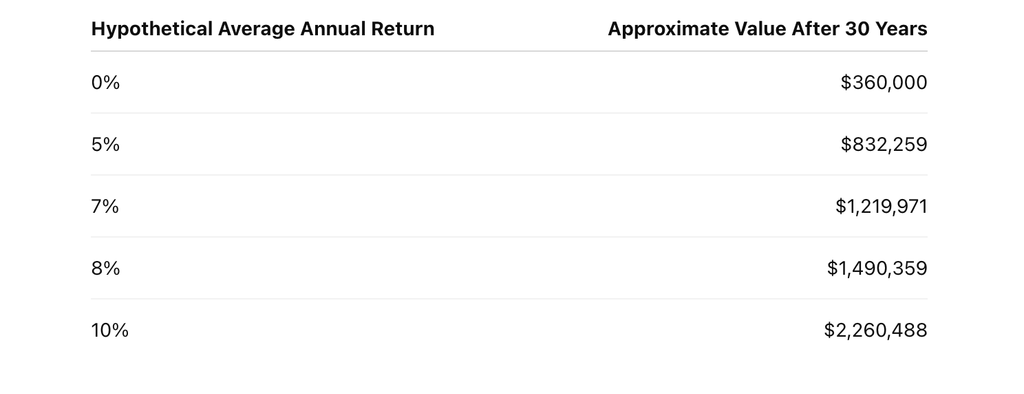
These examples assume that $1,000 is invested at the end of every month and that returns compound monthly. Investor.gov provides a compound interest calculator that uses the initial investment, monthly contribution, time period, estimated annual return, and compounding frequency to illustrate potential growth.
At a hypothetical 7% annual return, for example, investing $1,000 every month for 30 years could result in approximately $1.22 million, even though you contributed only $360,000 of your own money. The remaining amount would come from investment growth.
Why Does Compounding Matter?
Compound growth occurs when you earn returns on both the money you have invested and the returns that investment has already generated. Over a long period, that growth can become increasingly significant.
Investor.gov explains that regular investing combined with time can produce substantial growth through compounding, while also emphasizing that investments do not have a guaranteed rate of return and can fluctuate in value.
This is one reason starting earlier can be important. The longer money remains invested, the more time there is for potential returns to generate additional returns.
How Does This Relate to Real Estate?
Investing $1,000 a month does not necessarily mean putting $1,000 directly into an investment property every month. For someone interested in real estate, regular savings can instead be used to build funds for a future down payment, closing costs, renovations, reserves, or other expenses associated with purchasing property.
A person may also choose to invest in other assets while saving toward a future real estate purchase. The appropriate strategy depends on financial circumstances, investment goals, time horizon, and tolerance for risk.
For someone considering an investment property in the San Francisco Bay Area, building capital over time can be particularly important because property prices and transaction costs can make purchasing real estate a significant financial commitment.
Does $1,000 a Month Guarantee a Million Dollars?
No. The example of reaching approximately $1.22 million assumes a hypothetical 7% average annual return and consistent monthly contributions for 30 years. Actual investment returns can be higher or lower, and investments can lose value.
Investor.gov notes that investing involves risk and that market performance fluctuates over time. The agency also notes that some experts use a 7% to 10% annual return as a long term estimate for diversified U.S. stock investments based on historical averages, but these figures are not guaranteed returns.
The calculation should therefore be viewed as an illustration of the potential effect of consistent contributions and compounding rather than a promise of a particular result.
Consistency Can Matter More Than Timing
Building wealth over several decades is generally a long term process. Regular contributions can help establish a disciplined investing habit rather than relying on a single large investment at one point in time.
For prospective real estate investors, that same principle can apply to building a financial foundation before purchasing an investment property. Saving consistently, maintaining adequate reserves, reducing expensive debt, and understanding the costs of property ownership can all help prepare you for a future purchase.
Whether the goal is building an investment portfolio, saving for a down payment, or preparing for future Buying A Home decisions, understanding how money can grow over time can help you make more informed financial choices.
The most important takeaway is that $1,000 a month can become significantly more than $1,000 a month over a long enough period when investment returns are positive and compounded. Time, consistency, and a realistic understanding of risk are all important parts of a long term investment strategy.
What Should You Consider Before Buying an Investment Property?
Buying an investment property is a significant financial decision. A property can have strong rental demand and attractive long term potential, but those advantages do not automatically make it a good investment. Before making an offer, buyers should evaluate the property’s finances, condition, location, financing, and potential operating expenses.
Taking time to analyze these factors can help investors avoid costly surprises and determine whether a property fits their broader investment goals.
Start With the Location
Location can have a major influence on both rental demand and long term property value. Even properties with similar prices and features can perform very differently depending on the surrounding neighborhood.
When evaluating a potential investment property, consider factors such as:
• Rental demand in the area
• Access to employment centers
• Transportation options
• Schools and amenities
• Neighborhood development
• Comparable rental properties
• Recent comparable sales
• Local property taxes and regulations
For investors in the San Francisco Bay Area, these factors can vary significantly from one neighborhood and city to another. Looking at the local market rather than relying on broad regional assumptions can provide a more accurate picture of an individual property’s potential.
Evaluate the Purchase Price
The purchase price is one of the most important numbers in an investment analysis. A property may have attractive rental income, but paying too much can make it difficult to achieve the desired return.
Compare the property with similar homes that have recently sold in the same market. Consider the condition, size, location, features, and potential improvements when evaluating comparable properties.
It is also important to think about the property’s value after necessary improvements. A property that requires significant renovation may have potential, but those renovation costs should be included in the overall investment calculation.
Understand the Financing
Financing can have a major effect on the performance of an investment property. The interest rate, down payment, loan terms, closing costs, and monthly debt obligations can all affect cash flow.
Before purchasing, understand how much cash will be required upfront and how much the property will cost each month.
The analysis should include more than the mortgage payment. Investors should also account for property taxes, insurance, maintenance, utilities when applicable, property management, and other operating costs.
Calculate Expected Cash Flow
Expected rental income should be compared with the property’s total expenses. This can help determine whether the investment is likely to generate positive cash flow, break even, or require additional money from the owner.
A basic analysis may include:
Gross rental income
Minus vacancy and collection losses
Minus operating expenses
Equals net operating income
After considering financing costs, an investor can estimate the property’s potential cash flow.
It is important to use realistic rent estimates rather than assuming the highest advertised rent in the area. Comparable properties with similar size, condition, location, and amenities can provide a better reference point.
Inspect the Property’s Condition
A property that requires extensive repairs can significantly increase the initial investment. Before purchasing, carefully consider the condition of the roof, plumbing, electrical systems, heating and cooling equipment, appliances, windows, flooring, and other major components.
Renovation costs should be estimated before making a final investment decision. It may also be appropriate to budget for future capital improvements even when the property is currently in good condition.
A thorough property inspection can help identify potential issues, although an inspection cannot predict every future repair.
Research Rental Demand
A rental property needs tenants, so understanding local demand is essential. Research comparable rental properties to determine what similar homes are renting for and how quickly they are being leased.
Consider the characteristics that renters value in the area. Depending on the market, these may include location, parking, outdoor space, updated kitchens and bathrooms, access to transportation, and proximity to employment or schools.
Understanding the target renter can also help investors determine which property improvements are likely to provide meaningful value.
Consider Property Management
Owning an investment property can involve ongoing responsibilities. Owners may need to handle tenant communication, maintenance, repairs, rent collection, inspections, and other management tasks.
Some investors choose to manage their properties themselves, while others hire a professional property manager. If management services are used, the cost should be included in the financial analysis.
The decision may depend on the number of properties owned, the distance from the property, the investor’s available time, and the complexity of the investment.
Review Local Rules and Regulations
Local laws and regulations can affect how an investment property can be used and managed. Rules may address rental requirements, tenant protections, short term rentals, property improvements, inspections, zoning, and other issues.
These requirements can vary by location, so buyers should research the rules that apply to the specific property before making a purchase.
Professional legal and tax advice may also be appropriate when an investment involves complicated ownership, rental, or regulatory considerations.
Plan for Unexpected Expenses
Even a property that looks financially attractive on paper can encounter unexpected costs. A tenant may leave unexpectedly, a major appliance may fail, or a plumbing or roofing problem may require immediate attention.
Maintaining appropriate cash reserves can help an investor handle these situations without jeopardizing the property’s finances.
A sound investment analysis should therefore include not only expected expenses but also a reasonable allowance for vacancies, repairs, maintenance, and other unexpected costs.
Think About Your Long Term Goal
Before purchasing an investment property, determine what you want the property to accomplish.
Your goal might be:
• Generating rental income
• Building long term equity
• Potential property appreciation
• Diversifying your investments
• Creating future retirement income
• Expanding a real estate portfolio
The appropriate property can look very different depending on the goal. A buyer focused on current cash flow may prioritize rental income and operating expenses, while another investor may place greater emphasis on location and long term appreciation potential.
Work With Local Real Estate Expertise
Buying an investment property requires both financial analysis and an understanding of the local market. A real estate professional can provide insight into comparable sales, neighborhood conditions, property features, and the buying process.
For buyers considering an investment property in the San Francisco Bay Area, local market knowledge can be particularly valuable because conditions can vary considerably between communities.
Mark Tauber Real Estate helps clients navigate Buying A Home, Selling Your Home, and residential real estate opportunities throughout the San Francisco Bay Area. For buyers exploring an investment property, understanding the market and evaluating the property from multiple perspectives can help support a more informed decision.
Ultimately, the best investment property is not necessarily the most attractive or the most expensive property. It is the property whose financial performance, condition, location, and long term potential align with your investment objectives.
Buying A Home With Future Investment Goals in Mind
Buying a home is often viewed as a personal decision, but for some buyers, it can also be the first step toward a broader real estate strategy. A property purchased as a primary residence today may potentially become an investment property in the future if the owner eventually moves and chooses to rent it out.
Thinking about that possibility before Buying A Home can influence the way you evaluate location, property type, layout, condition, and long term potential.
Consider the Location Carefully
Location matters whether you are buying a primary residence or considering its potential as a future investment property. A home that is convenient for your current lifestyle may also benefit from characteristics that support future rental demand.
Consider factors such as:
• Access to employment centers
• Transportation options
• Schools and local amenities
• Neighborhood conditions
• Housing demand
• Nearby shopping and services
• Long term development plans
In the San Francisco Bay Area, conditions can vary considerably between cities and neighborhoods. A property that works well for your current needs may have very different future rental potential depending on its specific location.
Think About the Property Type
Not every home is equally suited to becoming a rental property. When considering a purchase, think about whether the property’s type, size, layout, and features would appeal to potential tenants in the local market.
For example, a home with functional bedrooms, adequate storage, parking, and a practical layout may have broader rental appeal than a property with highly specialized features.
This does not mean you should choose a home based entirely on its future rental potential. Your primary residence should still meet your own needs and budget. However, considering both your current goals and possible future uses can help you make a more strategic decision.
Pay Attention to the Floor Plan
A practical floor plan can be valuable for both homeowners and future renters. Consider how easily rooms can be used, whether there is sufficient storage, and whether the layout is likely to remain desirable over time.
Features that may contribute to broad appeal include:
• Functional bedrooms and bathrooms
• Adequate kitchen storage
• Practical living spaces
• Convenient laundry areas
• Parking where appropriate
• Useful outdoor space
• Flexible rooms that can serve multiple purposes
A flexible home may be easier to market to different types of buyers or renters later.
Avoid Over Personalizing the Property
Your primary residence should feel like your home, but extensive personalization can sometimes make a property less appealing to future buyers or renters.
Highly specialized renovations, unusual finishes, or expensive features designed for very specific tastes may not provide the same value to the broader market.
A more balanced approach is to create a home that reflects your preferences while maintaining broadly appealing design choices. Durable materials, functional improvements, and timeless finishes can often serve both purposes.
Consider Future Maintenance Costs
When Buying A Home with potential investment goals in mind, consider not only the purchase price but also the ongoing cost of maintaining the property.
Older systems, aging roofs, outdated plumbing, and other major components may require significant investment over time. Understanding the property’s condition can help you anticipate future expenses.
A property that requires extensive maintenance may still be a good purchase, but those costs should be considered when evaluating its long term financial potential.
Understand Financing and Future Rental Plans
Financing requirements can differ depending on whether a property is being purchased as a primary residence or as an investment property. If you are considering eventually converting your home into a rental, review your mortgage terms and other applicable requirements before making assumptions about future use.
Insurance requirements may also change when a property becomes a rental. Local rental regulations and tax considerations should be reviewed as well.
Because these issues can depend on individual circumstances, loan terms, and applicable laws, buyers should consult qualified lending, tax, and legal professionals when planning a future conversion.
Build Equity With Long Term Thinking
One potential benefit of owning a home is the opportunity to build equity over time. As the mortgage balance is reduced, the owner’s equity may increase, assuming other factors remain favorable.
That equity could potentially become part of a future real estate strategy. For example, an owner may eventually sell the property and use available proceeds toward another purchase, or retain the existing property as an investment property after moving.
Neither strategy is automatically better. The appropriate choice depends on the property’s financial performance, market conditions, personal circumstances, and long term objectives.
Evaluate the Property as Both a Home and a Future Asset
When a buyer believes a property could eventually become an investment property, it can be useful to look at it from two perspectives.
First, ask whether the property is an appropriate home for your current needs. Then consider whether the location, layout, condition, and expected expenses could make sense for a future rental or resale strategy.
This approach does not require predicting exactly what the real estate market will do years from now. Instead, it encourages buyers to think about flexibility and long term value before committing to a purchase.
San Francisco Bay Area Considerations
The San Francisco Bay Area contains a wide variety of housing markets, from dense urban neighborhoods to suburban communities. Rental demand, property prices, regulations, and housing characteristics can vary significantly from one area to another.
Local market expertise can therefore be valuable when evaluating a home with possible future investment potential. Understanding comparable sales, neighborhood trends, property characteristics, and buyer demand can help you make a more informed decision.
Mark Tauber Real Estate helps clients with Buying A Home and Selling Your Home throughout the San Francisco Bay Area. For buyers who may eventually want to convert a primary residence into an investment property, considering both current lifestyle needs and future possibilities can be an important part of the decision making process.
The ideal home today may not necessarily be the ideal investment property tomorrow, but choosing a well located, functional, and versatile property can give you more options as your goals change.
Turn Your Real Estate Goals Into a Clear Investment Strategy
Buying an investment property can be a meaningful step toward building long term wealth, but it requires careful planning and realistic expectations. From understanding the true definition of an investment property to evaluating rental income, operating expenses, financing, location, and potential appreciation, every factor can influence whether a property fits your goals.
The 2% rule can provide a quick starting point for evaluating rental properties, but it should never replace a detailed financial analysis. Likewise, starting with $5,000 or investing $1,000 each month can be part of a long term strategy, but the right approach depends on your financial position, investment timeline, and objectives.
For some buyers, an investment property may mean purchasing a dedicated rental property. For others, it may begin with Buying A Home that could potentially become a rental in the future. In either case, considering location, property condition, rental demand, expenses, and long term flexibility can help you make a more informed decision.
The San Francisco Bay Area offers a diverse range of residential real estate opportunities, but market conditions can vary considerably between neighborhoods and communities. Local knowledge can be especially valuable when comparing properties, estimating market value, understanding neighborhood characteristics, and evaluating potential rental demand.
Mark Tauber Real Estate is a residential real estate team serving clients throughout the San Francisco Bay Area. Whether you are Buying A Home, considering Selling Your Home, or exploring an investment property, having experienced local guidance can help you navigate the process with greater confidence.
Ready to Explore Your Investment Property Options?
Mark Tauber Real Estate can help you evaluate residential real estate opportunities and better understand how a potential investment property fits within your goals. Contact the team to discuss your plans, explore properties in the San Francisco Bay Area, and take the next step toward making a more informed real estate decision.